

Access Control Migration: Moving from Legacy Systems Without Downtime
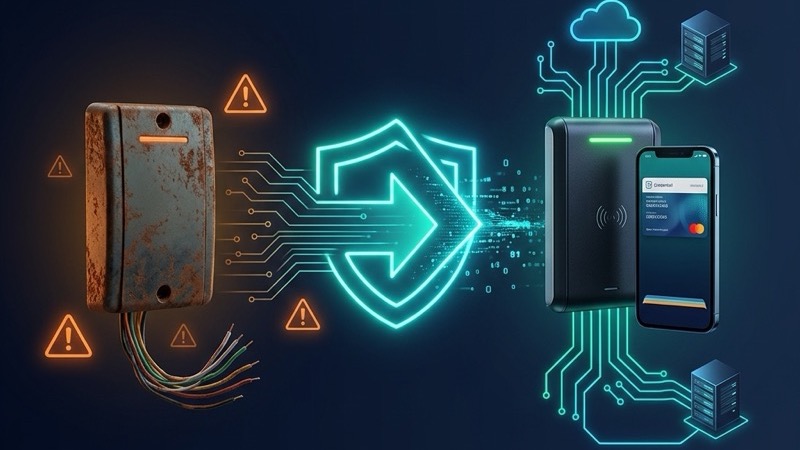
The security industry is facing a reckoning: the physical layer of access control has become its most exploitable vulnerability. For decades, the Wiegand protocol served as the undisputed industry standard, but in an era of sophisticated cyber-physical threats, this 1970s-era technology represents a massive security debt that is finally coming due. For enterprise IT managers and security professionals, the challenge is no longer deciding if to migrate, but how to execute an access control migration without paralyzing daily operations.
Modernizing a security ecosystem often carries the stigma of “rip-and-replace” — a process notorious for causing “locked-out” employees and operational blackouts. However, recent advancements in hybrid-cloud architectures and unified software layers have made zero-downtime transitions a reality. By moving toward SIA OSDP v2.2 and mobile-first credentials, organizations can trade vulnerable, unencrypted wires for a secure, bi-directional environment that integrates directly with existing identity infrastructure like Microsoft Entra ID (formerly Azure AD) or Workday.
The Hidden Vulnerabilities of Legacy Wiegand Infrastructure and the High Cost of Migration Downtime
The persistence of Wiegand-based systems in modern enterprises is a paradox of convenience over security. Because Wiegand is a one-way, unencrypted protocol, the data traveling from the badge reader to the controller is essentially “in the clear,” leaving it wide open to exploitation.
The “ESPKey” Threat: Why Wiegand Sniffing is a Critical Liability
The primary driver for immediate migration is the accessibility of “sniffing” and “replay” attacks. Tools like the ESPKey — a low-cost, thumb-sized device — can be surreptitiously installed behind a reader in seconds. Once attached, it captures credential data as it passes through the Wiegand wires. This data can then be replayed to grant unauthorized entry or harvested to clone physical badges. Because Wiegand lacks a “heartbeat” or supervision, the system has no way of knowing a sniffing device has been spliced into the line, making it a silent and persistent liability.
Quantifying the Financial Impact of Access Control System Downtime
While the security risk is clear, the fear of downtime often stalls migration projects. For a global enterprise, a single day of system-wide downtime doesn’t just mean “open doors”; it triggers a total loss of audit trails, the need for expensive physical security guards at every entrance, and the cessation of automated visitor management. The financial impact includes not only the immediate labor costs of a manual “fire watch” but also the potential for SOC 2 or GDPR compliance violations if PII (Personally Identifiable Information) or secure zones are compromised during the blackout.
Transitioning to OSDP v2.2: Why Encryption and Bi-Directional Communication Are Non-Negotiable
The Security Industry Association (SIA) released OSDP v2.2.2 in October 2024, cementing it as the benchmark for secure physical access. Unlike its predecessor, OSDP (Open Supervised Device Protocol) is built on the RS-485 standard, enabling high-speed, secure communication that Wiegand simply cannot match.
Understanding AES-128 Encryption and Transparent Mode Functionality
At the core of OSDP v2.2 is the AES-128 encryption “Secure Channel.” This ensures that even if a bad actor physically taps the wires, the data remains unreadable. Furthermore, the industry has seen a major shift following HID Global’s announcement to release patents on Transparent Mode. This feature allows the controller to communicate directly with a smart card’s secure element, bypassing the reader’s internal processing. This ensures that the most sensitive credential data is handled by the most secure part of the architecture, fostering true interoperability between different hardware vendors.
The Benefits of Bi-Directional Communication for Remote Firmware Updates
One of the most significant operational advantages of OSDP is its bi-directional nature. In a Wiegand environment, updating reader firmware or changing a configuration requires a technician to physically visit every door with a configuration card or a laptop. With OSDP v2.2, these tasks are handled remotely via the controller. This “supervised” connection also provides real-time diagnostics — if a reader is tampered with or loses power, the system triggers an immediate alert, allowing for proactive maintenance rather than reactive repair.
Wiegand vs. OSDP v2.2 Comparison
| Feature | Wiegand (Legacy) | OSDP v2.2 (Modern) |
|---|---|---|
| Communication | One-way (Simplex) | Bi-directional (Duplex) |
| Security | Unencrypted / “In the clear” | AES-128 Encryption |
| Wiring | Multi-conductor (5–12 wires) | RS-485 (2-wire twisted pair) |
| Supervision | None (No “heartbeat”) | Continuous Supervision |
| Max Distance | ~500 feet | ~4,000 feet |
| Remote Management | Not possible | Firmware updates & configuration |
Debunking the “Rip-and-Replace” Myth: Leveraging Hybrid-Cloud Architectures for Zero-Downtime Cutovers
The most successful enterprise migrations avoid the “big bang” approach. Instead, they utilize Hybrid-Cloud Architectures to bridge the gap between legacy on-premise hardware and modern Access Control as a Service (ACaaS).
Implementing Parallel Infrastructure to Maintain Site Security During Cutover
To achieve zero downtime, organizations install the new system in parallel with the old one. By using dual-technology readers (supporting both 125 kHz Proximity and 13.56 MHz MIFARE DESFire EV3/Mobile), you can keep your legacy cards active while simultaneously provisioning new credentials. This “side-by-side” installation allows the security team to test the new OSDP-based controllers — such as the Suprema CoreStation, which supports up to 500,000 users — without disconnecting the existing system. This ensures that security remains airtight while the new infrastructure is vetted.
Zone-by-Zone Migration Strategies for Large-Scale Enterprise Facilities
Rather than attempting to migrate an entire campus at once, a phased cutover targets specific zones. You might begin with the data center and executive suites (high-security zones) before moving to general office areas. This allows the IT team to refine the migration process and ensure that the network infrastructure (PoE+ power and RS-485 cabling) is performing as expected before the final legacy server is decommissioned. This modular approach minimizes risk and allows for real-time troubleshooting without affecting the entire facility.
Orchestrating Seamless Data Migration via API-First Unified Security Platforms
The biggest bottleneck in any migration is data. Manually re-entering thousands of users, access levels, and schedules into a new system is not only inefficient but also a major security risk due to human error.
Automating User Provisioning Through Identity Provider Integrations
Modern migration strategies prioritize an “API-first” approach. By connecting the access control system to the organization’s “Source of Truth” — typically an HR database like Workday or an identity provider like Microsoft Entra ID — user provisioning becomes automated.
In practice, organizations synchronize their cloud identity provider with on-premises Active Directory (via tools like Microsoft Entra Connect), and the access control platform picks up changes automatically through its native Active Directory integration. When a new employee is hired in your HR system, their credential — physical or mobile — is automatically generated in the access control system. During migration, this synchronization ensures that no user is “lost” between the old and new databases, maintaining a continuous audit trail.
Managing Multi-Protocol Environments with Universal Software Layers
During the transition period, which can last months for large enterprises, you need a software layer capable of managing both the legacy and modern hardware simultaneously. This is where unified platforms become essential for maintaining operational continuity.
Utilizing CredoID for Unified Hardware Management and Legacy Integration
Midpoint Security addresses this challenge through its CredoID platform. CredoID is designed for high-stakes environments where hardware variety is a reality. It provides a unified interface that supports over a dozen hardware platforms — including HID Global, Mercury Security, Suprema, Tanlock, and mobile readers — allowing security managers to monitor legacy doors and new OSDP-secured portals from a single pane of glass. By leveraging CredoID’s native integration with Active Directory, organizations can ensure that permissions remain consistent across the entire facility, regardless of which stage of the migration a specific door is in.
Future-Proofing the Perimeter: A Strategic Roadmap for Mobile-First Credentialing and Digital Wallet Integration
The final objective of a modern migration is to eliminate the logistical burden of physical badges. In 2025 and 2026, the industry has seen a massive move toward mobile-first provisioning.
Step-by-Step Implementation: From Site Audit to Mobile Provisioning
Transitioning to mobile credentials involves moving beyond simple Bluetooth (BLE). Modern systems now integrate with Apple Wallet and Google Wallet using NFC (Near Field Communication). This provides a “frictionless” experience where users don’t even need to unlock their phones to gain entry. Furthermore, the adoption of UWB (Ultra-Wideband) in high-traffic areas like turnstiles offers centimeter-level spatial accuracy, allowing for true “hands-free” access that feels seamless to the end-user.
Platforms like CredoID support multiple mobile credential providers — including HID Origo and STID Mobile-ID — giving organizations the flexibility to choose the best fit for their environment without being locked into a single vendor’s ecosystem.
Establishing a Long-Term Maintenance Cycle for Firmware and Security Patches
Migration isn’t a one-time event; it is the beginning of a new lifecycle. Because OSDP v2.2 allows for remote management, your security team must establish a regular cadence for firmware updates. Just as IT departments patch servers, security departments must now patch readers and controllers to defend against newly discovered vulnerabilities. Platforms like CredoID simplify this by centralizing the firmware management of all connected devices, ensuring your infrastructure remains resilient against the threats of tomorrow.
Getting Started: Your Access Control Migration Playbook
If you are ready to retire your Wiegand “security debt,” follow this structured implementation path to ensure a smooth transition.
Step 1: Conduct a Comprehensive Infrastructure Audit
Identify every reader, controller, and cable run. Determine if your current cabling (multi-conductor) can support RS-485 (twisted pair) for OSDP or if a “re-pull” is required. Identify high-risk zones that require immediate AES-128 encryption to mitigate the threat of sniffing attacks.
Step 2: Select “Bridge” Hardware
Invest in dual-technology readers (e.g., HID Signo) and controllers that support both legacy and modern protocols. This allows you to support your existing card population while transitioning to mobile credentials, preventing a “day one” hardware lockout.
Step 3: Deploy a Unified Management Layer
Implement a software solution like CredoID to manage the hybrid environment. Connect it to your on-premises Active Directory — which can be synchronized with your cloud identity provider (Microsoft Entra ID) or HR system (Workday) — to automate user provisioning and eliminate the manual data entry errors that often plague large-scale migrations.
Step 4: Execute a Phased Zone-by-Zone Cutover
Start with a pilot program in a single department or building. Use the side-by-side method to test OSDP secure channels and mobile credential “tap-and-go” functionality before scaling to the rest of the enterprise. This allows you to catch potential network issues early.
Step 5: Provision Mobile & Wallet Credentials
Deploy digital wallet credentials via platforms like HID Origo or STID Mobile-ID. This reduces the cost of physical badge replacement and provides a superior user experience for employees and contractors alike, finally moving your security posture into the 21st century.
To see how a unified approach can simplify your transition to modern security standards, request a demo of the CredoID platform today.
About Midpoint Security
Midpoint Security is a leader in open-architecture access control software. Our flagship product, CredoID, empowers organizations to break free from vendor lock-in. By supporting industry standards like OSDP v2.2 and integrating with world-class hardware from HID Global, Mercury Security, Suprema, and more, we provide the flexibility and security required for modern enterprise environments.