

Integrating LPR (License Plate Recognition) with CredoID
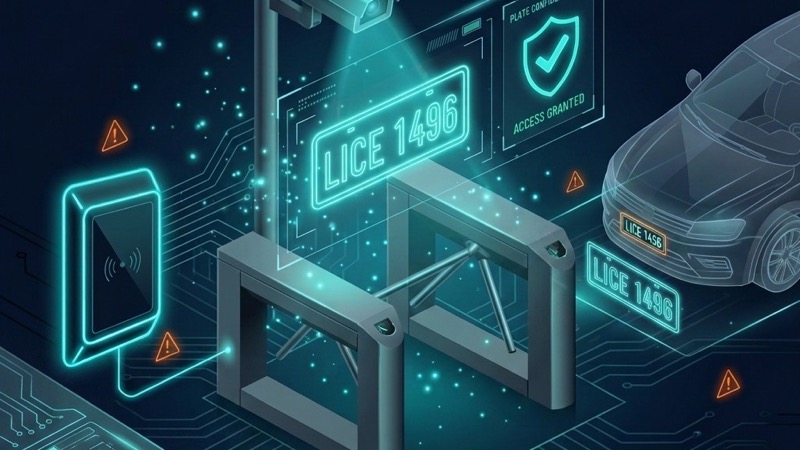
Vehicle access control has long served as the “weak link” in perimeter security. For decades, facilities relied on long-range RFID tags glued to windshields or physical badges handed through driver-side windows—methods notoriously prone to hardware failure, theft, and agonizing traffic bottlenecks. However, the evolution of License Plate Recognition (LPR) has fundamentally shifted this paradigm. By treating the vehicle’s license plate as a secure, virtual credential, organizations can now achieve frictionless entry without compromising oversight.
Modern LPR integration is no longer just about capturing a static image; it is about seamless data synchronization between high-performance edge hardware and central management software like CredoID. This integration utilizes Edge-AI and standardized communication protocols to ensure that a vehicle’s arrival triggers the same rigorous logic—such as anti-passback rules and time-zone restrictions—as a high-security door reader.
This article explores the technical architecture required for a professional LPR deployment, the critical importance of multi-factor vehicle identification through vehicle metadata verification (Make, Model, and Color), and how UAB Midpoint Systems enables a “Privacy by Design” approach to meet modern regulatory standards like GDPR.
Beyond the Gate: Solving Modern Perimeter Security Challenges with LPR Integration
Legacy vehicle access control systems often buckle under the physical constraints of their hardware. Long-range RFID readers frequently suffer from “cross-lane interference,” where a reader for Lane A accidentally triggers the gate for Lane B. Furthermore, physical tokens are easily lost, stolen, or transferred between vehicles, creating a significant security gap. LPR integration solves this by transforming the vehicle itself into the credential, eliminating the logistical burden of proprietary tags and reducing the total cost of ownership (TCO) associated with credential lifecycle management.
The Limitations of RFID and Long-Range Readers in High-Traffic Environments
In high-traffic settings, such as logistics hubs or corporate campuses, every second of delay at the gate ripples back into local traffic. RFID systems require vehicles to slow down significantly or stop entirely to ensure a successful read. If a tag is damaged or positioned incorrectly, the driver must resort to manual intercom intervention, stalling the entire queue. LPR systems, particularly those utilizing high-speed shutters (1/1000s or faster), allow for “free-flow” access where authorized vehicles can be identified and cleared while still in motion, significantly increasing throughput.
Transitioning from Reactive Surveillance to Proactive Access Management
Historically, LPR was a tool for reactive surveillance—searching recorded video after an incident occurred. By integrating LPR directly into an Access Control System (ACS) like CredoID, the plate data moves from the Video Management System (VMS) into the active identity management workflow. This transition allows security teams to move beyond “seeing what happened” to “controlling what happens,” utilizing real-time plate data to grant or deny access based on the same database used for employee badges.
The Architecture of Intelligence: Edge-AI, ONVIF Profile M, and Metadata Synchronization
The technical foundation of modern LPR has shifted from server-heavy Optical Character Recognition (OCR) to Edge-AI processing. Previously, cameras would stream high-bandwidth raw video to a central server, which then performed the heavy lifting of character extraction. This created massive network strain and single points of failure. Today, cameras powered by chipsets like the Axis ARTPEC-8 perform OCR on-board, sending only lightweight metadata (JSON/XML) to the ACS.
Leveraging Edge-AI for Real-Time Plate Extraction
Edge-AI processing can significantly reduce network bandwidth consumption. Instead of a 4K video stream, the camera sends a compact metadata packet containing the plate string and an OCR Confidence Score. This score is critical for gate automation; practitioners typically set a “Gate Trigger” threshold (e.g., >90%) to ensure that only high-certainty reads activate the barrier, while lower scores trigger a secondary verification or a manual alert to the security desk.
Secure Data Transmission via OSDP v2 Secure Channel and Encrypted Metadata Streams
Interoperability is maintained through ONVIF Profile M, a global standard released in 2021 to unify metadata and event analytics. This allows an LPR camera from one manufacturer to communicate seamlessly with software like CredoID without proprietary drivers. For the physical connection to the controller, the industry is moving away from the unencrypted Wiegand protocol toward OSDP v2 (Open Supervised Device Protocol). OSDP v2 Secure Channel ensures that the communication between the LPR camera (acting as a peripheral) and the controller is fully encrypted and bidirectional. CredoID provides native OSDP configuration per reader, including baud rate, reader address, and Secure Channel toggle.
| Feature | Legacy Server-Based LPR | Modern Edge-AI LPR |
|---|---|---|
| Processing Location | Central Server | On-Camera (Edge) |
| Bandwidth Usage | High (Raw Video Streaming) | Low (Metadata Push) |
| Standardization | Proprietary SDKs | ONVIF Profile M / RESTful API |
| Security Protocol | Unencrypted Wiegand (Legacy) | OSDP v2 Secure Channel |
| Data Enrichment | Plate Number Only | Plate + Make, Model, Color |
Orchestrating the Integration: Mapping License Plates as Virtual Credentials within CredoID
The true power of LPR integration is realized when the software treats a license plate not as an “event,” but as a virtual credential. Within the CredoID environment, a license plate string is mapped directly to a user profile as part of an Identification Set—alongside cards, PINs, and biometrics—just like an HID Origo mobile ID or a standard RFID badge. This “credentialization” allows the plate to inherit all the sophisticated logic already built into the security system, including time-zone restrictions, access levels, and anti-passback enforcement.
Configuring CredoID for Seamless Camera-to-Controller Communication
CredoID provides live synchronization with HID Aero and Mercury controllers, allowing real-time updates to access rules. When an LPR camera identifies a plate, CredoID’s Host Identification engine processes the access decision—evaluating the plate against its authorization database, the assigned access levels, and active door modes. If the plate is authorized, CredoID instructs the controller to trigger the gate relay. CredoID supports a dedicated LPR only door access mode specifically designed for gates and barriers controlled exclusively by license plate recognition.
Implementing Multi-Factor Vehicle Identification to Prevent Plate Cloning
A rising threat in perimeter security is “plate cloning,” where an unauthorized vehicle uses a printed duplicate of an authorized plate. CredoID helps mitigate this through multi-factor vehicle identification. Beyond the alphanumeric plate string, each license plate record in CredoID stores the vehicle’s Make, Model, and Color. If a registered plate is detected on a vehicle that does not match the stored vehicle profile, the system can flag the discrepancy for investigation. Combined with camera-side Edge-AI analytics that can detect vehicle type and color, this provides a level of security that standard RFID tags simply cannot match.
Challenging the “Plug-and-Play” Myth: Environmental Calibration and Privacy Compliance
While the software integration is streamlined, the physical deployment of LPR requires meticulous environmental calibration. Standard security cameras often fail at LPR because they cannot handle “headlight bloom” or lack the shutter speed necessary to freeze a moving vehicle’s plate. Furthermore, the legal landscape for vehicle tracking is tightening, necessitating a proactive approach to data governance.
Mitigating Environmental Variables: Angle, Illumination, and Speed
To achieve high accuracy rates, installers must account for:
- Shutter Speed: A minimum of 1/1000s is required for moving vehicles to prevent motion blur.
- IR Illumination: High-intensity Infrared (IR) is necessary to overcome the glare from headlights and tail lights.
- Capture Angle: The vertical and horizontal angles should generally not exceed 30 degrees to ensure the OCR engine can accurately map the characters.
Navigating Data Privacy: Automated Purging and PII Encryption Strategies
License plate numbers are classified as Personally Identifiable Information (PII) under GDPR and CCPA. Emerging legislation in the U.S., including proposed amendments to federal highway bills and state-level ALPR regulation laws (such as Washington State’s SB 6002 and Connecticut’s H.B. 5449), further limit the warrantless collection and long-term retention of vehicle movement data. Professional deployments must implement “Privacy by Design.” CredoID supports this through its built-in Cleanup system, which provides configurable automated data purging—allowing administrators to set retention policies for event logs and ensuring that historical data is deleted within the organizationally or legally required window to maintain compliance.
Quantifying the ROI of Automated Vehicle Access and Future-Proofing Your Facility
Integrating LPR with a unified platform like CredoID delivers measurable gains in both security posture and operational efficiency. For enterprise IT managers, the scalability of the system is a primary driver; CredoID’s architecture is designed to scale from small deployments managing a single gate to enterprise-grade installations managing thousands of doors across multiple sites.
Measuring Throughput Efficiency and Reduced Administrative Overhead
By automating entry, facilities can reduce the need for dedicated gate guards or administrative staff to manage physical vehicle tags. The ROI is found not just in labor savings, but in the reduction of “false rejects.” When a plate is unreadable due to mud or extreme weather, integrated systems can offer a “False Reject Protocol,” such as a secondary BLE (Bluetooth Low Energy) mobile credential or an integrated intercom, ensuring that authorized traffic never grinds to a halt.
A Strategic Roadmap for Phased LPR Deployment and System Scaling
For organizations looking to future-proof their facility, LPR serves as a gateway to the broader IoT ecosystem. The adoption of MQTT (Message Queuing Telemetry Transport) allows LPR events to be broadcast to Building Management Systems (BMS). For example, a “VIP Arrival” event triggered by a plate read can automatically adjust HVAC settings or prepare lighting in a specific wing of the building.
Implementation Playbook: Getting Started with LPR and CredoID
Step 1: Audit Your Environmental Infrastructure
Evaluate your gate entrance for lighting conditions and mounting positions. Ensure you can achieve a camera angle of less than 30 degrees and that you have sufficient IR illumination to counter headlight bloom.
Step 2: Select ONVIF Profile M Compliant Hardware
Choose cameras (such as Axis or Hanwha Vision) that support Edge-AI and ONVIF Profile M. This ensures that the metadata can be ingested by CredoID without the need for custom, high-maintenance drivers.
Step 3: Define Your “OCR Confidence” Thresholds
Work with your security team to determine the balance between security and convenience. A 90% confidence score is a standard starting point for automated gate triggers, with anything lower being flagged for manual review.
Step 4: Configure “Credentialized” Plates in CredoID
Map your plate database to existing user profiles. Assign time-zones and access levels to these virtual credentials to ensure that vehicle access follows the same policy framework as internal door access.
Step 5: Establish Data Governance Protocols
Set up automated purging rules within CredoID to comply with GDPR or applicable local regulations. Ensure that historical event data is deleted within the legally required window to maintain compliance.
Ready to modernize your perimeter security? Get a Demo to see how CredoID handles real-time LPR integration and multi-factor vehicle identification.
| — |