

The State of Physical Access Control in 2026: What’s Real, What’s Next, and What to Ignore
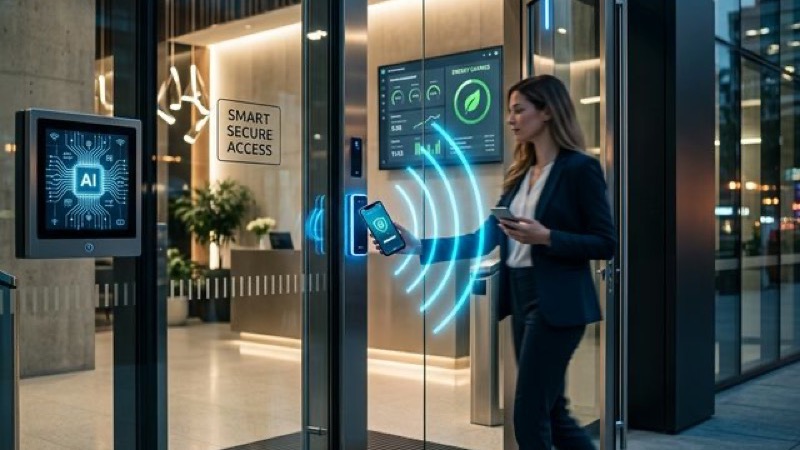
A no-nonsense look at physical access control in 2026. From mobile wallets and UWB to the real impact of AI and Zero Trust, here’s what security leaders need to know now.
Physical access control has quietly become one of the most consequential technology decisions an enterprise makes. Not because the locks got smarter—they did—but because the data flowing through those locks now touches HR, IT, facilities, sustainability reporting, and cybersecurity. The door reader is an endpoint. The badge is an identity. And the audit trail is a compliance asset.
Yet most of the “2026 trends” content circulating online reads like a press release: vague, vendor-neutral to the point of uselessness, and disconnected from the operational realities of managing access across multi-site enterprises.
This article takes a different approach. We’ll examine what’s actually changing in the physical access control (PAC) landscape, separate signal from noise, and offer a practitioner’s perspective on the decisions that matter this year.
The Shift That Underpins Everything Else: Software-Defined Access Control
Before discussing individual trends, it’s worth naming the structural change that enables all of them: the decoupling of access control logic from hardware.
Historically, access control was defined by the controller on the wall. Proprietary wiring, closed protocols, and single-vendor lock-in were the norm. A system upgrade meant ripping out infrastructure.
In 2026, the dominant architecture is software-defined. Open-platform solutions—built on controllers from manufacturers like HID Global (AERO, VERTX EVO) and Mercury Security (EP/LP series)—allow enterprises to choose hardware and software independently. The Open Supervised Device Protocol (OSDP v2) has effectively replaced the legacy Wiegand standard for reader-to-controller communication, bringing encrypted, bidirectional data exchange to the door.
This matters because every trend that follows—mobile credentials, AI analytics, cloud management, sustainability integration—depends on having a software layer that isn’t welded to a specific vendor’s firmware.
1. Mobile Credentials Have Graduated. Wallet-Based Access Is the New Baseline
Mobile credentials aren’t new. What’s new in 2026 is that they’ve moved from pilot programs to default deployment mode. The mobile access credential market is projected to surpass $750 million by 2028 (up from $295 million in 2022), with a compound annual growth rate of roughly 17%.
Where the Industry Actually Is
- Bluetooth Low Energy (BLE) remains the most widely deployed mobile credential protocol in 2026, supported by virtually all modern readers.
- NFC (Near Field Communication) has gained significant ground thanks to native support in Apple Wallet, Google Wallet, and Samsung Wallet. Wallet-based credentials are particularly attractive because users already trust these platforms for payments, and the provisioning model is familiar.
- Ultra-Wideband (UWB) is the technology to watch. With centimeter-level precision, UWB enables true “hands-free” access—the door unlocks as the authorized user approaches, without a tap or phone wake. The UWB access control market reached $1.41 billion in 2024 and is projected to grow at 19.8% CAGR through 2033. New IEEE 802.15.4ab chips arriving in 2025–2026 bring lower power consumption and enhanced security.
What This Means in Practice
The plastic badge isn’t dead, but its role is shrinking. Organizations deploying wallet-based credentials report three operational improvements: elimination of badge printing and shipping logistics, instant remote provisioning and revocation (a new hire’s credential can be pushed to their phone before they arrive on Day 1), and built-in multi-factor authentication via the smartphone’s biometric unlock (Face ID, fingerprint).
The prerequisite? Your access control platform must support OSDP v2 readers capable of BLE, NFC, and eventually UWB. Proprietary reader ecosystems are the single biggest barrier to mobile credential adoption.
2. AI in Access Control: Moving Past the Hype Cycle
Every vendor is marketing “AI-powered” access control. Here’s what’s genuinely useful versus what’s still aspirational.
What AI Actually Does Well Today
- Anomaly detection in access patterns. Modern platforms ingest swipe/tap data and learn baseline patterns. If a credential that normally enters at 9 AM on weekdays suddenly badges in at 2 AM on a Saturday, the system flags it—not as a retrospective report, but as a real-time alert with context.
- Natural language querying. Instead of exporting CSV logs and running pivot tables, administrators can query: “Which credentials accessed the server room outside business hours in the past 30 days?” The system returns structured results. This isn’t science fiction; it’s a production feature in platforms like CredoID that expose rich API-driven data models.
- False alarm reduction in integrated systems. When access control is unified with video surveillance, AI cross-references access events with camera feeds. A “door forced open” alarm can be automatically downgraded if the camera confirms a delivery driver propping the door—reducing alarm fatigue by up to 80% in some deployments.
What’s Still Aspirational
“Fully autonomous threat mitigation”—where the system locks down zones without human input—remains limited to controlled environments. In most enterprises, AI surfaces decisions; humans make them. And that’s the correct architecture for now.
3. The Convergence of Physical and Cyber Security Is No Longer Optional
For years, physical security and IT security operated as separate fiefdoms with separate budgets, separate teams, and separate risk registers. In 2026, that separation is a vulnerability.
Why Convergence Accelerated
The attack surface expanded. Access control panels are IP-connected devices on corporate networks. Edge controllers run firmware that requires patching. Readers communicate via encrypted protocols that can be misconfigured. A compromised access control system doesn’t just open doors—it provides lateral movement into OT and IT networks.
The regulatory environment caught up. Frameworks like NIST and IEC 62443 now treat physical access systems as cyber-physical assets. Auditors ask whether your door controllers are on the same patch management schedule as your servers.
Zero Trust Applied to Physical Access
The Zero Trust model—”never trust, always verify”—now extends to physical identity. This means:
- Continuous authentication, not just badge-at-the-door. In high-security environments, systems cross-reference credential location with indoor positioning. If a badge is used in Building A while the associated phone is in Building B, access is revoked in real time.
- Certificate-based controller authentication. Controllers and readers authenticate to the management platform using TLS certificates, not just network placement. This prevents rogue hardware from being introduced into the access fabric.
- Unified identity governance. The same identity lifecycle that manages Active Directory or Azure AD accounts now manages physical access credentials. When an employee is terminated in the HR system, their physical credential is revoked within minutes, not days.
4. Access Control as a Sustainability Data Source
This is the trend most access control vendors underestimate, and the one that CFOs and facilities directors care about most.
Occupancy Data Drives ESG Reporting
Access control systems know exactly how many people are in a building, on a floor, or in a zone—and when. This data, historically used only for security, is now a primary input for:
- HVAC and lighting automation. When an access system detects that a floor is unoccupied after 6 PM, it signals the Building Management System (BMS) to reduce heating/cooling and dim lights. Organizations coupling PAC data with BMS report measurable reductions in energy consumption.
- LEED and BREEAM certification. Sustainability certifications increasingly require documented proof of occupancy-based energy management. Access control data provides auditable, timestamped evidence.
- Real estate optimization. Post-pandemic, many enterprises are right-sizing office space. Access data reveals which floors, zones, and desks are actually used versus allocated—informing lease negotiations and office redesigns.
The Technical Requirement
This integration requires an access control platform with an open API capable of exporting occupancy data in real time to BMS, IWMS (Integrated Workplace Management Systems), and ESG reporting platforms. Closed, proprietary systems that don’t expose this data are leaving value on the table.
5. Access Control as a Service (ACaaS): Hybrid Is the Honest Answer
The industry has debated “cloud vs. on-premise” for a decade. In 2026, the answer for most enterprises is hybrid.
Why Pure Cloud Doesn’t Work for Everyone
- Uptime requirements. Doors need to open even when the internet is down. Edge controllers must cache credentials and operate autonomously during connectivity gaps.
- Data residency. Organizations in regulated industries (healthcare, defense, government) face constraints on where access data can be stored and processed.
- Existing infrastructure. Most enterprises have decades of wiring and hardware. A rip-and-replace to go fully cloud-native is neither practical nor economical.
What Hybrid Actually Looks Like
- Edge controllers handle real-time access decisions locally—zero latency, zero dependency on cloud availability.
- Cloud management provides centralized configuration, remote firmware updates, cross-site reporting, and global policy management.
- API-first architecture allows the access platform to integrate with cloud-native HR systems, identity providers, and analytics platforms without requiring the access decisions themselves to route through the cloud.
This is where open-platform architecture becomes critical. Solutions built on open standards (OSDP, REST APIs, standard database interfaces) can operate in hybrid mode natively. Proprietary platforms often force a binary choice.
6. Comparing Access Control Architectures
| Capability | Legacy (Pre-2020) | Transitional (2021–2024) | 2026 Best Practice |
|---|---|---|---|
| Credential | Proximity / Wiegand | Mobile (BLE) | Wallet-based / UWB |
| Reader Protocol | Wiegand (unencrypted) | OSDP v1 | OSDP v2 (encrypted, bidirectional) |
| Architecture | On-premise, single-vendor | Hybrid pilot | Software-defined, open-platform |
| Data Usage | Audit logs only | Real-time dashboards | AI analytics, ESG reporting, BMS integration |
| Cyber Posture | Air-gapped (assumed secure) | Network-connected (unmanaged) | Zero Trust, managed as IT endpoint |
| Integration | Hardwired / proprietary | SDK-based | Open REST API, webhook-driven |
| Sustainability | Not measured | Awareness stage | Core ESG data source |
What This Means for Your Next Decision
If you’re evaluating or upgrading an access control system in 2026, here are the questions that matter:
- Is the platform software-defined and hardware-agnostic? If you can’t swap out a reader or controller without replacing the entire system, you’re buying into a dead architecture.
- Does it support OSDP v2 and mobile wallet credentials? These aren’t future-proofing—they’re table stakes.
- Can it export data via open APIs? If your access system can’t feed data to your BMS, HR platform, or SOC, it’s a silo.
- Is it managed as a cyber asset? Your access controllers need the same patching, monitoring, and certificate management as any other endpoint on your network.
- Does the vendor’s roadmap include UWB and AI-driven analytics? These are moving from differentiators to expectations within the next 18 months.
About CredoID
CredoID is an open-platform access control and security software designed for organizations that refuse to be locked into proprietary ecosystems. With support for HID, Mercury, and STid hardware, a REST API with over 400 integration calls, and a web-first management interface, CredoID gives security teams the flexibility to build systems that work the way their organization works—not the way a hardware vendor dictates.