

GDPR and Physical Security: Navigating Data Privacy in 2026
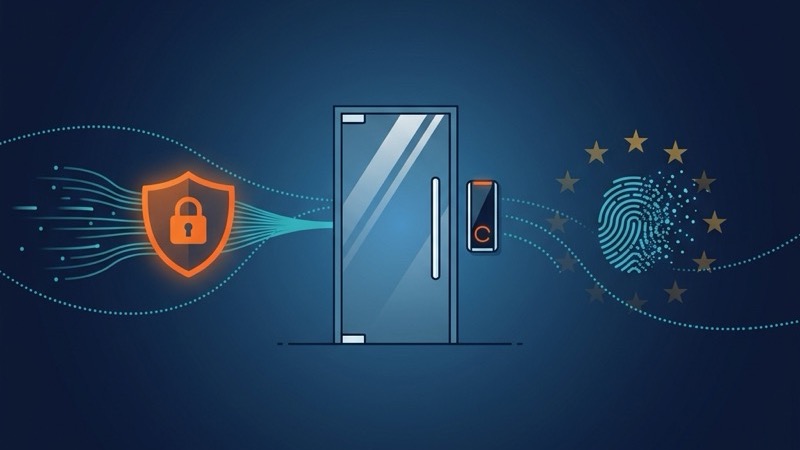
By 2026, the wall between physical security and digital data privacy has vanished. For security professionals and IT managers, the “air-gap” myth—the idea that physical access control systems are isolated from corporate data risks—is officially dead. Security auditors and regulators increasingly view unencrypted communication between readers and controllers as a failure to implement appropriate technical measures under GDPR Article 32, creating significant compliance risk.
This transition is driven by the scheduled application of the EU AI Act’s high-risk provisions from August 2, 2026, and the updated ISO/IEC 27701:2025 standard. Organizations can no longer rely on paper-based privacy policies. Compliance now demands what the industry calls “technical truth”—the principle that technical implementation must demonstrably match written privacy commitments, and that hardware itself must provably protect “Special Category” biometric data. This article explores the mandatory transition to encrypted protocols, the legal implications of the EU AI Act on surveillance, and how to architect a physical security stack that minimizes liability.
Note on the EU AI Act timeline: The EU Digital Omnibus, currently in trilogue negotiations as of early 2026, proposes extending the high-risk AI deadline to December 2, 2027. Until the amended text is formally adopted, the original August 2, 2026 date remains legally in force. Organizations should prepare for the earlier deadline while monitoring the legislative process.
What is GDPR in Physical Security?
GDPR in physical security refers to the application of the General Data Protection Regulation to the collection, storage, and processing of personal data via access control systems, video surveillance, and biometric readers. In 2026, this specifically focuses on Article 9 (Special Category Data) and Article 35 (Data Protection Impact Assessments), requiring protocols like OSDP v2.2 and Edge-AI privacy masking to ensure “Security by Design.”
The Erosion of the “Air-Gapped” Myth: Why Physical Security is the New GDPR Frontier
In 2026, physical security is a primary front in GDPR enforcement. The legacy mindset that “door security is just hardware” creates significant legal exposure. Regulators now view every access event—a badge swipe, a face scan, or license plate recognition—as a data processing event that must be secured end-to-end.
The Death of Wiegand and the Rise of Mandatory OSDP v2.2 Encryption
The industry has reached a terminal point for the Wiegand protocol. Long the standard for reader-to-controller communication, Wiegand’s lack of encryption and bidirectional capability is now cited in security audits as a failure to protect personal data under GDPR Article 32. Because Wiegand data streams are easily intercepted with low-cost “sniffing” devices such as ESPKey, transmitting a user’s unique identifier over an unencrypted line constitutes a significant compliance risk.
Practitioners are now standardizing on OSDP (Open Supervised Device Protocol) v2.2. Based on the international standard IEC 60839-11-5 and released in its current form in December 2020 by the Security Industry Association (SIA), OSDP v2.2 utilizes AES-128 encryption through a Secure Channel (SC). This creates a bidirectional, encrypted link that prevents “man-in-the-middle” attacks. For enterprise IT managers, the mandate is clear: any system still utilizing Wiegand is a compliance liability that must be decommissioned to meet the “Security by Design” requirements of GDPR.
Why “Security by Design” Now Dictates Hardware Procurement Cycles
GDPR Article 25 requires “Data Protection by Design and by Default.” In 2026, privacy cannot be an “add-on” feature; it must be baked into the procurement cycle. When evaluating new hardware, security professionals must verify that devices support modern encryption and privacy standards.
One key certification to consider is ISO/IEC 27701:2025, the Privacy Information Management System (PIMS) standard. As of the 2025 edition, ISO 27701 can now be pursued as a standalone certification—organizations no longer need to first achieve full ISO 27001 ISMS certification, though the two standards remain designed to align. This standalone pathway makes privacy-focused certification more accessible for physical security operations. Procurement teams are prioritizing vendors who provide “embedded compliance,” where hardware automatically enforces data retention limits and encryption standards without manual intervention.
From Paper Policies to Technical Truth: Navigating the EU AI Act and Edge-AI Surveillance
Regulators in 2026 have moved beyond “paper compliance.” The era of handing an auditor a written privacy policy is over. Data Protection Authorities now increasingly use automated tools and technical verification during audits, testing whether an organization’s actual backend operations match its stated privacy promises. This shift—often described as “technical truth” in industry discourse—means that the technical reality of your system, not its documentation, determines your compliance posture.
Edge-AI and Dynamic Privacy Masking: Balancing Security Analytics with Anonymization
With the EU AI Act’s high-risk provisions scheduled to apply from August 2, 2026, surveillance providers have shifted toward Edge-AI. This technology performs real-time “Privacy Masking”—the dynamic blurring of faces and license plates—directly on the camera before footage is even transmitted to a recorder.
This allows for essential security analytics, such as “person down” detection or loitering alerts, without the legal burden of processing identifiable personal data. By processing data at the edge and transmitting only anonymized metadata, organizations reduce their liability under both GDPR and the EU AI Act.
The Impact of the EU AI Act on High-Risk Biometric Monitoring
Under the EU AI Act, any physical security system categorized as “high-risk” under Annex III must be registered in the EU AI database before being placed on the market or put into service. This includes AI-driven systems used for employee monitoring or biometric categorization (e.g., using AI to estimate age, gender, or emotional state). These systems must undergo third-party conformity assessments by a Notified Body to ensure they do not exhibit bias or violate fundamental rights.
| Feature | Legacy Surveillance (Pre-2026) | GDPR-Compliant Edge-AI (2026) |
|---|---|---|
| Data Processing | Centralized (Server-side) | Distributed (Edge-side) |
| Privacy Masking | Static or Post-processed | Dynamic / Real-time at Source |
| Biometric Handling | Centralized Database (High Risk) | Decentralized / Anonymized |
| Regulatory Status | GDPR only | GDPR + EU AI Act (mandatory); ISO/IEC 42001 (voluntary, recommended) |
| Audit Requirement | Policy Review | Technical verification audit |
Note on ISO/IEC 42001: ISO/IEC 42001:2023 is a voluntary AI Management System standard. While not legally required, it provides a recognized framework for demonstrating responsible AI governance and can complement mandatory GDPR and EU AI Act compliance.
Architecting Compliance: Transitioning to OSDP v2.2 and Decentralized Biometric Frameworks
Achieving compliance in 2026 requires a fundamental architectural shift. The goal is to minimize the Data Controller’s liability footprint by moving away from massive, centralized databases of sensitive biometric information.
Eliminating Centralized Risk via Match-on-Card and Template-on-Mobile Architectures
To reduce the compliance burden of centralized biometric databases under GDPR Article 9, organizations are moving toward Match-on-Card or Template-on-Mobile architectures.
Under these models, the biometric template (a mathematical representation, not a raw image) is stored exclusively on the user’s encrypted smart card or smartphone. When the user presents their credential, biometric verification happens locally on the device or reader. The central server never “sees” or stores the biometric template; it only receives a “Yes/No” authentication result. This can significantly reduce the scope of an organization’s obligations as a Data Controller, as the biometric template never enters systems under the organization’s direct control.
However, organizations should note that adopting Match-on-Card does not exempt them from other GDPR obligations. A lawful basis for processing must still be established, a Data Protection Impact Assessment (DPIA) is still required, and individuals must be informed about how their biometric data is used.
Standardizing Bidirectional Communication for Real-Time Audit Trails
One primary benefit of OSDP v2.2 is its bidirectional nature. Unlike Wiegand, which only sends data from the reader to the controller, OSDP allows the controller to “supervise” the reader. This provides a real-time audit trail of hardware health and security status. For GDPR compliance, organizations can demonstrate that encryption was active at the exact moment a specific data packet was sent, providing the technical proof required for modern audits.
Midpoint Security: Implementing Credential Management that Bridges Legacy Gaps
Modern access control platforms like CredoID, developed by Midpoint Security, are designed to facilitate the transition from legacy to compliant infrastructure. CredoID supports OSDP Secure Channel (SC) with per-reader configuration—enabling administrators to toggle encrypted communication on a per-device basis—and provides mobile credential provisioning through external credential provider integrations.
This means organizations can manage the migration away from Wiegand readers incrementally, enabling OSDP Secure Channel on new readers while maintaining connectivity with legacy devices during the transition window. CredoID’s bidirectional OSDP support also enables real-time reader status monitoring, providing tamper detection and online/offline supervision that contributes to the continuous audit trail regulators expect.
It is important to note that CredoID operates at the access control software layer—managing readers, controllers, credentials, and access events. Features like Edge-AI privacy masking and Match-on-Card biometric verification operate at the camera/VMS and reader hardware layers respectively. A compliant 2026 security stack requires coordinating solutions across all these layers.
Beyond the Consent Box: Challenging the Assumption that User Agreement Justifies Invasive Collection
A common misconception among security professionals is that obtaining user consent is a “silver bullet” for data collection. In 2026, this assumption is legally dangerous.
The Failure of Kiosk Consent: Why DPAs Require Genuine Choice
Regulators have found that many visitor management kiosks use “forced consent,” where a visitor cannot enter the building unless they agree to invasive data collection. Under GDPR, this is not “freely given” consent—consent requires a genuine choice, and if the data subject has no real alternative, the consent is invalid.
When visitor data collection is necessary for security or safety purposes (such as emergency evacuation lists), “legitimate interests” under Article 6(1)(f) is often a more appropriate legal basis than consent. If relying on legitimate interests, organizations must still provide clear privacy notices and conduct a balancing test to ensure the processing does not override visitors’ rights.
Technical verification audits now examine whether systems actually suppress data when they should. If a visitor clicks “Reject All” on a kiosk, the system must physically stop data packets from being generated or stored in real-time. Simply having a privacy policy that says “we don’t store your data” is insufficient if system logs still show identifiable metadata.
Reducing Liability Through Architectural Choices
For Access Control as a Service (ACaaS) deployments, data residency is paramount. Organizations must know where access logs are stored (EU vs. US) and understand the implications of the EU-U.S. Data Privacy Framework, which remains active but continues to face legal challenges before the CJEU.
By utilizing decentralized biometric templates (via Match-on-Card or Template-on-Mobile) and Edge-AI anonymization, an organization can reduce the scope of personal data under its control. Under GDPR, if the organization never possesses identifiable biometric templates, its obligations as a Data Controller for that specific data category are substantially narrowed. This architectural choice is a powerful tool for IT managers looking to reduce corporate risk.
Organizations deploying CredoID can further simplify data residency by choosing on-premise deployment, keeping all access logs and personal data within their own infrastructure rather than relying on third-party cloud storage.
The 2026 Compliance Roadmap: Conducting Technical DPIAs and Hardening the Physical Security Stack
Future-proofing your physical security requires a continuous Data Protection Impact Assessment (DPIA) cycle. Under GDPR Article 35, a DPIA is mandatory for any deployment involving AI, biometrics, or large-scale public monitoring.
Step-by-Step Guide to Performing a Technical Audit on Access Control Systems
To ensure your system meets 2026 standards, follow this implementation playbook:
- Audit the Physical Layer: Identify every reader-to-controller connection. Any connection using Wiegand must be flagged for immediate upgrade to OSDP v2.2 with AES-128 encryption.
- Verify Biometric Storage: Determine where biometric templates are stored. If they are in a centralized database, evaluate a transition to Match-on-Card or Template-on-Mobile to reduce Article 9 compliance burden.
- Validate Edge-AI Masking: If using video surveillance, verify that privacy masking happens “at the edge” on the camera itself. Use packet-sniffing tools to confirm that identifiable faces are not being transmitted to the VMS (Video Management System).
- Execute a Technical DPIA: Beyond the standard paperwork, perform a technical test of your “Reject All” functions on kiosks and visitor portals. Ensure data suppression happens at the database level—verify by inspecting actual system logs after a test rejection.
- Review Data Residency: For cloud-based security (ACaaS), audit your vendor’s data storage locations. Ensure all access logs and personal data are stored within the EU or under a verified Data Privacy Framework agreement. Consider on-premise deployment where data sovereignty is a priority.
- Pursue ISO/IEC 27701:2025 Certification: Move toward the standalone PIMS certification for physical security operations to provide a recognized framework for privacy controls.
Integrating Physical Security into the Corporate Data Governance Framework
Physical security can no longer exist as a siloed department. Security professionals must collaborate with the Chief Privacy Officer (CPO) and IT managers to integrate access control data into the broader corporate data governance framework. This includes setting automated data retention periods—for example, configuring automatic deletion of access logs after a defined period (such as 30 days) unless a legal hold is required. The specific retention period should be determined by the organization’s DPIA and applicable local regulations.
Conclusion: The Path Forward with Midpoint Security
The regulatory landscape of 2026 leaves no room for unencrypted legacy systems or centralized biometric risks. By standardizing on OSDP v2.2, evaluating Match-on-Card architectures for biometric deployments, and preparing for the EU AI Act, organizations can transform physical security from a GDPR liability into a pillar of corporate trust.
CredoID from Midpoint Security provides key capabilities for this transition: OSDP Secure Channel support with per-reader encryption configuration, bidirectional reader supervision for continuous audit trails, and mobile credential provisioning through external provider integrations. These tools help organizations demonstrate verifiable compliance in a regulatory environment that increasingly demands technical proof over paper promises.
Ready to secure your facility and your data? Get a Demo to see how CredoID can help you navigate the complexities of GDPR and OSDP v2.2 compliance.