

The Hidden Costs of Proprietary Security Hardware Lock-ins
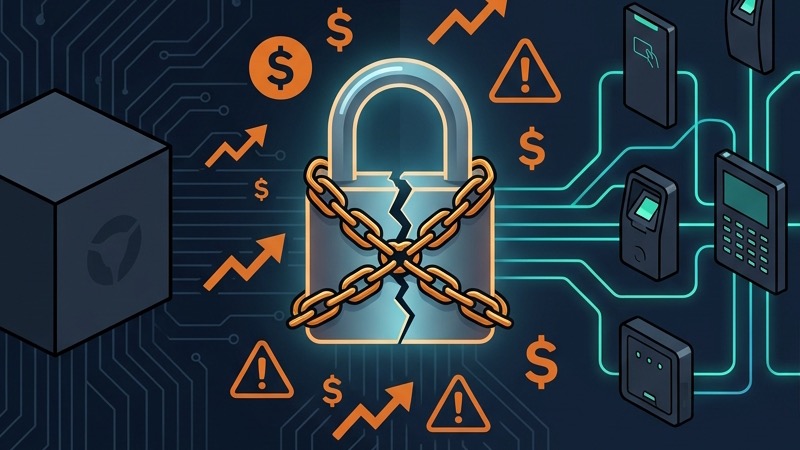
Installing a proprietary access control system is often framed as a “seamless end-to-end solution”, but for enterprise IT managers, it frequently becomes a multi-year financial anchor. When a vendor controls both the hardware firmware and the software management layer through closed APIs, the customer loses the ability to shop for competitive pricing or integrate best-of-breed technologies. This “lock-in” creates a cycle of dependency where the cost of switching exceeds the cost of enduring annual price hikes for proprietary credentials and mandatory service maintenance agreements (SMAs).
The Evolution of Access Control: From Wiegand Vulnerabilities to the High Price of Security Debt
Legacy proprietary systems rely heavily on the Wiegand protocol, a communication standard with roots in the 1970s. While Wiegand was revolutionary for its time, it lacks encryption and bi-directional communication, creating what can be described as “security debt”—accumulated risk from outdated infrastructure that compounds over time. Proprietary vendors often use this debt as leverage, forcing customers into expensive, vendor-specific hardware refreshes rather than offering a path toward open interoperability.
The Hidden Vulnerabilities of One-Way Communication
Wiegand is a one-way, unencrypted protocol. It transmits credential data in the clear, making it susceptible to simple “sniffing” attacks where a low-cost device can intercept and replay card data. Proprietary vendors historically “solved” this by wrapping the communication in a closed-loop ecosystem. However, this didn’t fix the underlying protocol; it simply ensured that only their specific (and more expensive) readers could talk to their specific controllers. This lack of bi-directional communication means the central server cannot “talk back” to the reader to verify its health or push firmware updates, leading to undetected hardware failures and manual site visits that inflate operational costs.
Why Proprietary “Wrappers” Fail to Solve Modern Encryption Needs
To address the Wiegand security gap, many vendors introduced proprietary encrypted protocols. While these may provide strong encryption, they do so by creating a “walled garden.” If you want to move to mobile credentials or high-frequency smart cards, you are restricted to that vendor’s specific product roadmap. If the vendor lags on new standards—or discontinues a hardware line—you are left with a system that cannot be upgraded without a total “rip-and-replace” of every reader and controller on the premises.
The Financial Trap of Closed Ecosystems: Credential Taxes and Forced Hardware Refreshes
The most immediate financial impact of hardware lock-in is the “credential tax.” This is the inflated cost of purchasing proprietary physical or mobile credentials that only work within a specific vendor’s ecosystem.
The True Cost of Proprietary Mobile Credentials
As organizations migrate to mobile access using NFC (Near Field Communication) and BLE (Bluetooth Low Energy), proprietary vendors have shifted their revenue models. Instead of a one-time hardware sale, they often charge recurring “per-seat” or “per-user” licensing fees for mobile credentials. These fees are a direct result of API lock-in; because the proprietary hardware will not communicate with third-party mobile wallet apps or open-standard protocols, the customer is forced to pay the vendor’s integration tax indefinitely. While physical card costs vary primarily by technology—basic encrypted smart cards typically range $5–$15 per unit, though high-security variants may cost more—the true credential tax emerges with mobile credentials, where proprietary platforms charge recurring per-user fees that open-standard systems can avoid.
NDAA Section 889 and the Risk of Non-Compliant Vendor Dependencies
Regulatory shifts are exposing additional dangers of proprietary silos. NDAA Section 889 prohibits federal agencies and their contractors from procuring or using video surveillance and telecommunications equipment from specific Chinese manufacturers, including products containing components from Huawei subsidiaries such as HiSilicon. While the regulation primarily targets cameras and video surveillance infrastructure—where prohibited chipsets are most commonly found—any security device containing components from the named manufacturers as a substantial or essential part of the system is also subject to the prohibition.
In an open-architecture system, an IT manager can swap a non-compliant camera or device for an alternative while keeping their existing access control software. In a proprietary system where the video management, access control, and hardware are tightly coupled, a compliance issue in one layer can force replacement across the entire stack, resulting in significant capital expenditure (CapEx) spikes.
Open Standards vs. Proprietary Silos: Evaluating the Total Cost of Ownership (TCO)
To accurately measure the impact of vendor lock-in, organizations must look beyond the initial sticker price to the 5-year Total Cost of Ownership (TCO).
What is OSDP?
OSDP (Open Supervised Device Protocol) is the SIA-developed standard for secure, bi-directional communication between readers and controllers. OSDP v2.2 supports AES-128 encryption via Secure Channel and enables bi-directional communication, allowing the controller to supervise reader health in real time.
Comparing Interoperability and Long-term Scalability
The industry is moving toward OSDP Verified hardware, a third-party testing program by the Security Industry Association (SIA). This distinguishes truly interoperable devices from those that are merely “compliant”—a self-declared claim that does not require independent testing. By specifying OSDP Verified components, organizations can mix and match readers and controllers based on performance and price rather than brand loyalty.
| Feature / Metric | Proprietary “Walled Garden” | Open Architecture (e.g., CredoID + Mercury) |
|---|---|---|
| Primary Protocol | Proprietary/Wiegand Wrapper | OSDP v2.2 (AES-128 Secure Channel) |
| Hardware Interoperability | Low (Single-vendor only) | High (Multi-vendor, OSDP Verified) |
| Mobile Credential Cost | High (Recurring per-user licensing) | Flexible (multiple credential provider options) |
| API / Integration Access | Restricted (Fees per integration) | Open (REST API, standard integrations) |
| Regulatory Resilience | Poor (Tightly coupled stack replacement) | High (Modular component replacement) |
| Reader Supervision | Limited (No bi-directional monitoring) | Bi-directional health monitoring with tamper detection |
| Controller Firmware Management | Vendor-dependent release cycles | Centralized firmware management from software layer |
A modular approach, where software like CredoID manages industry-standard hardware (such as Mercury Security or HID Global controllers), significantly reduces TCO by eliminating the “integration tax” typically charged to allow hardware to communicate with third-party HR or ERP systems.
Breaking the Lock-in: A Strategic Migration Path Toward Hardware-Agnostic Security
Reclaiming operational sovereignty doesn’t require an immediate, site-wide hardware replacement. Instead, a phased migration allows organizations to transition from legacy security debt to a modern, hardware-agnostic posture.
Step-by-Step Transition from Legacy Wiegand to Secure OSDP
Many modern readers support both Wiegand and OSDP interfaces, often with manufacturer-specific auto-detect capabilities that determine the communication protocol based on the connected controller. This dual-mode support is critical for phased upgrades: organizations can install dual-mode readers today, wired initially to legacy Wiegand controllers, and then upgrade the controllers later to unlock full AES-128 encryption and bi-directional health monitoring. When planning this transition, ensure the selected readers explicitly support dual-mode output (check the manufacturer’s documentation), and budget for RS-485 re-wiring when upgrading controllers from Wiegand to OSDP.
Leveraging Midpoint Security for Universal Hardware Integration
Midpoint Security provides the software intelligence necessary to bridge these hardware gaps. By utilizing CredoID, security professionals can manage a diverse hardware landscape—including HID VertX and Aero controllers, Mercury Security panels, Suprema biometric readers, Tanlock smart locks, and various OSDP-compliant devices—from a single dashboard. CredoID works with major hardware platforms precisely because open architecture means choosing software that doesn’t lock you into a single vendor’s ecosystem, even when working with the very hardware brands that also offer closed alternatives. This prevents the “API lock-in” common in cloud-only proprietary systems, and CredoID’s REST API enables integration with third-party HR, ERP, and visitor management systems without restrictive licensing fees.
Getting Started: An Implementation Playbook for Security Professionals
If you are managing a proprietary system and are concerned about long-term TCO, follow this four-step audit to regain control of your infrastructure.
Step 1: Audit Your Security Stack for Compliance Risks
Review your video surveillance infrastructure for equipment from manufacturers named under NDAA Section 889 (Huawei/HiSilicon, ZTE, Hytera, Hikvision, Dahua). Check camera and NVR specifications against the regulation’s requirements. For access control hardware, verify that your controllers and readers do not contain components from these manufacturers as a substantial or essential part of the system. Prioritize zones with non-compliant devices for your first hardware refresh.
Step 2: Demand “OSDP Verified” Status
For any new hardware procurement, specify SIA OSDP Verified (not just “compliant”). OSDP Verified means the device has undergone independent, third-party testing by the SIA. Self-declared “compliance” does not carry the same assurance of interoperability. This ensures that bi-directional communication and encryption features work across different brands, preventing future lock-in.
Step 3: Evaluate Mobile Credential Portability
Analyze your current mobile access costs. Are you paying a recurring fee per user? Does your platform support integration with multiple credential providers, or are you restricted to a single vendor’s mobile wallet? If you’re locked into per-user fees with no alternative, you are paying an integration tax that can be reduced by moving to a hardware-agnostic software platform that supports multiple credential providers.
Step 4: Pilot a Hardware-Agnostic Software Layer
Transitioning your head-end software to a platform like CredoID allows you to keep your existing functional hardware while opening the door to new, competitive hardware options. This decoupling of software and hardware is the only way to permanently end vendor lock-in.
About Midpoint Security: Midpoint Security develops CredoID, a high-end security management software designed for maximum hardware flexibility. By supporting industry standards like OSDP and integrating with leading hardware providers including Mercury Security, HID Global, and Suprema, CredoID empowers enterprise users to build secure, scalable, and cost-effective access control systems without the burden of proprietary lock-ins.
Ready to see how an open architecture can reduce your security TCO? Get Demo